


Hard money lenders give real estate investors something traditional banks usually can’t: speed. That makes them the go-to source of capital for time-sensitive deals, fix-and-flip projects, and properties that need work before a bank will touch them. But hard money loans also come with higher rates, shorter terms, and far less standardization than conventional financing, which means the lender you choose matters just as much as the deal itself. Picking the wrong partner can mean hidden fees, inflexible terms, or a closing that falls apart at the worst possible moment.
Gauntlet Funding’s guide covers everything you need to evaluate a hard money lender: the criteria that separate a strong partner from a mediocre one, the red flags that signal a predatory lender, how local and national lenders stack up against each other, and the direct questions to ask before you sign a term sheet.
Hard money loans are typically asset-based, short-term, and priced higher than a conventional mortgage, which is the trade-off investors make for speed and flexibility. That trade-off only pays off if the lender on the other side of the table is transparent, experienced, and reliable. A lender who cuts corners on documentation, underwriting, or communication can turn a fast-close advantage into a costly liability. Vetting a lender thoroughly, before you need the money, is what protects the deal.
Not all private lenders operate the same way. Before you commit to a lender, run them through these eight criteria.
Research the lender’s history before you apply. Look for a solid record of closed transactions, positive client testimonials, and a real presence in industry networks, online forums, and local real estate investor groups. A lender who can point to a track record of repeat borrowers is a good sign; one who can’t is a warning sign.
Years in the business matter, but experience in your specific market and property type matters more. A lender who understands neighborhood trends, local zoning rules, and construction costs in your area can offer insight that goes well beyond the loan itself, helping you avoid overpaying for a property or misjudging a renovation budget.
Confirm that the lender is properly licensed and certified to operate in the state where your property is located. This protects you legally and is a baseline indicator that the lender operates within an established regulatory framework rather than off the books.
A reliable lender will lay out the full cost of capital in plain language: interest rates, points, loan-to-value (LTV) ratio, and all fees associated with the loan. Look closely for hidden administrative, underwriting, or “junk” fees buried in the fine print, and make sure prepayment penalties, balloon payments, and renewal terms are spelled out clearly before you sign.
Speed is one of the main reasons investors turn to hard money in the first place. Traditional banks often take 30 to 60 days to close; a streamlined hard money lender can fund a deal in as little as 7 to 10 business days. Ask any lender you’re considering about their average time-to-fund, and make sure it lines up with your contract deadlines.
Hard money lending is built around the value of the deal, the property’s current value and after-repair value (ARV), rather than your personal credit score or debt-to-income ratio. A strong lender will also offer flexibility in how the loan is structured: adjusting LTV, draw schedules, or repayment terms to fit your specific project instead of forcing you into a rigid, one-size-fits-all product.
A lender who skips due diligence on the property and the deal is taking on more risk than they should, and passing that risk to you. Look for lenders who conduct real property assessments and financial evaluations rather than rubber-stamping applications. Rigorous due diligence on their end is a sign of a lending partner who intends to be around for the long term.
Read independent reviews on Google, Yelp, and the Better Business Bureau (BBB) to see how a lender treats borrowers once the ink is dry. A lender worth working with responds promptly, provides regular updates on loan progress and draw requests, and treats the relationship as a genuine partnership rather than a transaction.
According to RealtyTrac, 34% of fix-and-flip investors relied on private funding specifically for its speed and flexibility advantages, underscoring how much a lender’s responsiveness and process actually matter to the bottom line.
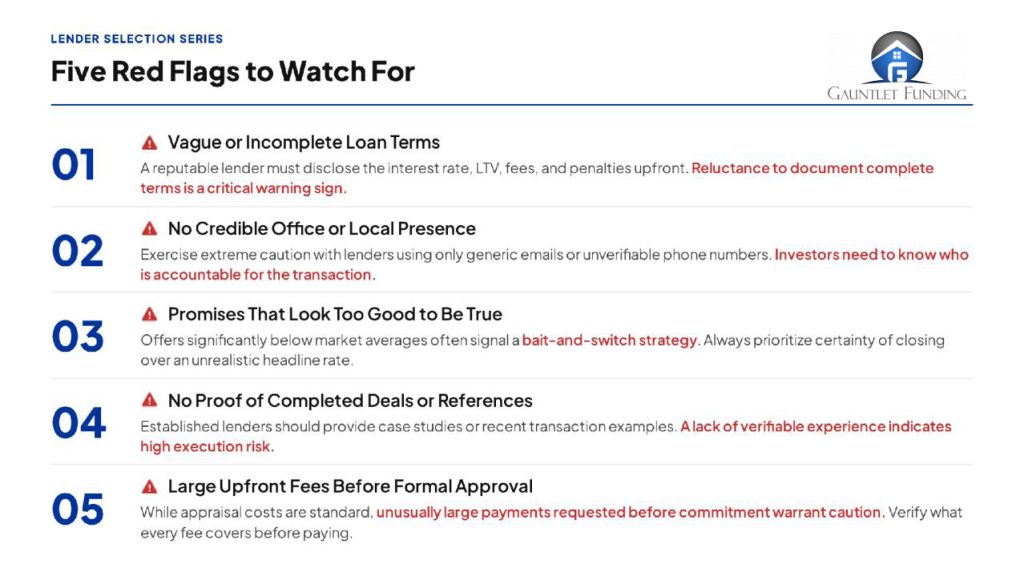
Not every hard money lender operates with the same transparency or ethical standards. Knowing the warning signs early can save you from a costly mistake.
Legitimate lenders provide clear, easy-to-understand documentation. Be wary of any lender reluctant to disclose the exact interest rate, LTV ratio, and all fees and penalties up front. A refusal to fully document loan terms is one of the clearest signs of predatory practices.
Reputable lenders typically have a real office and a team you can speak with directly. Be cautious of lenders who only offer a generic email address or an out-of-state number with no way to meet in person or by video.
If a lender is advertising rates far below the market, treat it as a bait-and-switch warning sign rather than good fortune. Always compare offers from multiple lenders to confirm you’re seeing a fair, competitive rate.
Trustworthy lenders can point to case studies or put you in touch with past borrowers. A lender who won’t share any verifiable examples may be inexperienced, or worse.
Small application or appraisal fees are normal. Requests for thousands of dollars before a formal loan approval is issued are not; that pattern is common among scam lenders.
“Hard money loans are often the last resort for borrowers, so lenders may take advantage by imposing steep fees and penalties. Investors must scrutinize the fine print to avoid hidden traps.” – Investopedia
The American Association of Private Lenders (AAPL) reports that more than 65% of complaints in the private lending sector involve hidden fees or undisclosed terms, the single biggest reason due diligence on the front end pays off.
Beyond vetting an individual lender, investors also have to weigh a broader question: work with a local lender or a national one? Each comes with real trade-offs.
The right choice depends on your project, timeline, and how many markets you’re active in. If you value regional expertise and a closer relationship, a local lender is likely the better fit. If you need scale, multi-state reach, or larger loan amounts, a national lender may serve you better. Either way, look past the headline rate; customer service, reliability, and adaptability matter just as much.
“A hard money loan is a type of secured loan that is typically used for real estate transactions. The loan is secured by the value of the property and is often issued by private investors or companies.” – Investopedia
CoreLogic reports that investors accounted for over 26% of all single-family home purchases in 2023, with many of those deals financed through alternative sources like hard money lenders, and ATTOM Data has found that cash and private financing account for 30% to 40% of all single-family flips nationally.
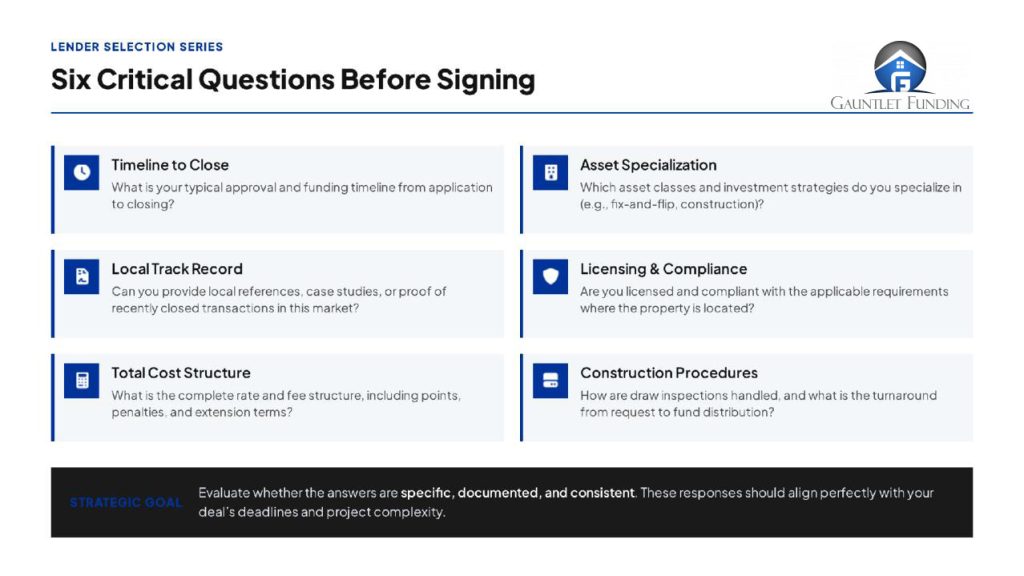
Before you commit to a term sheet, get direct answers to these questions:
At Gauntlet Funding, we’ve spent over 20 years financing REOs, short sales, construction projects, and residential and commercial properties of every kind and condition. We believe hard money loans should be a game-changing resource for real estate investors, not a source of hidden risk, which is why we build every relationship on transparency, education, and client-focused service.
Whether you’re comparing local and national lenders, sizing up red flags, or simply looking for a faster path to your next closing, we’re here to help you ask the right questions and move forward with confidence.
Ready to work with a lending partner who puts your success first? Apply for a hard money loan with Gauntlet Funding today.
Financial Disclaimer
The information provided is for educational and informational purposes only. The content on this website is not intended to be a substitute for personalized financial advice. Please consult a certified financial professional before making any investment decisions or financial plans. Any financial information presented is for general informational purposes and does not constitute financial or investment advice.








