



Real estate scaling requires financing that matches the speed of the modern market. While conventional bank financing serves a purpose for primary residences, it frequently bottlenecks active real estate investors looking to expand their portfolios. For those acquiring residential or commercial investment properties, understanding the mechanics of alternative financing is essential to long-term success.
When comparing DSCR Loans against traditional mortgages, the fundamental difference lies in how a lender measures risk. Traditional financing focuses heavily on your personal financial health, whereas debt service coverage programs evaluate the income potential of the real estate asset itself. This distinction changes everything from the application timeline to your ultimate borrowing capacity.
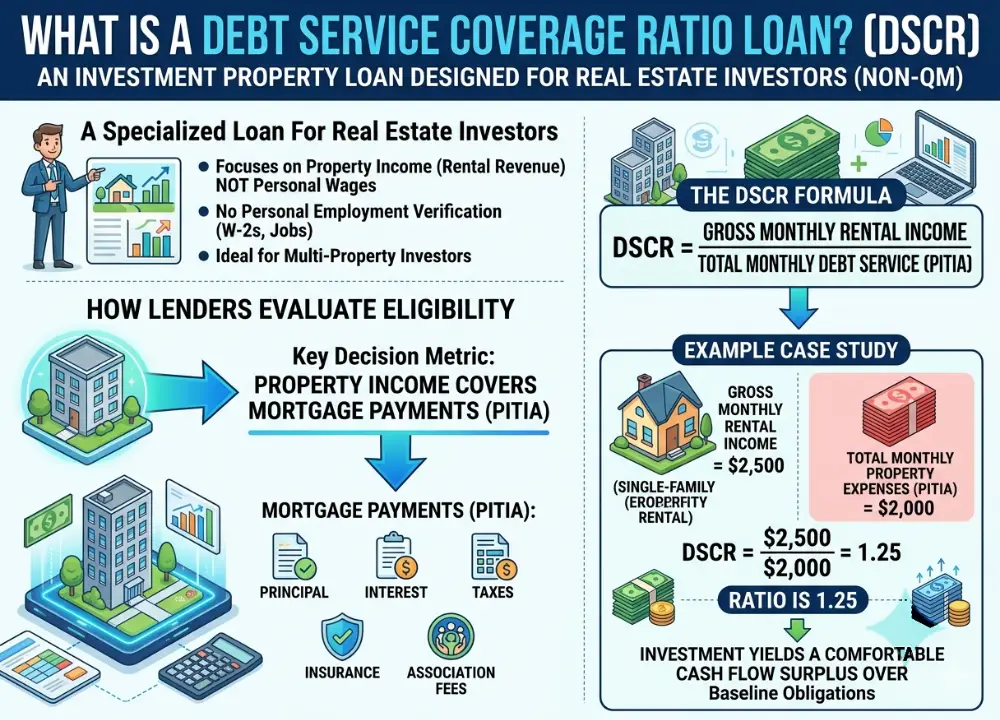
A debt service coverage ratio loan is a specialized, non-QM (Non-Qualified Mortgage) investment property loan designed specifically for real estate investors. Instead of verifying your personal wages, W-2 tax forms, or employment history, lenders use a specific mathematical formula to determine eligibility. They evaluate whether the rental income generated by the target property can successfully cover the monthly mortgage payments, including principal, interest, taxes, insurance, and association fees (PITIA).
This formula creates the debt service coverage ratio. For example, if a property generates $2,500 per month in gross rental income and the total monthly property expenses come out to $2,000, the ratio is calculated by dividing the income by the debt service. In this scenario, the resulting metric is 1.25, indicating that the investment yields a comfortable cash flow surplus above its baseline financial obligations.
Choosing between asset-based investment loans and standard conventional financing impacts how your financial profile is scrutinized. Traditional mortgage underwriting relies on strict personal debt-to-income (DTI) calculations. Lenders look closely at your personal credit card balances, auto loans, and existing home mortgages to ensure your personal income can absorb another recurring liability.
Asset-based non-QM underwriting completely removes personal DTI from the equation. Because the real estate asset acts as the primary driver of the approval, you do not have to provide years of tax returns or explain seasonal fluctuations in your personal business income. This makes debt service lending an incredibly powerful tool for self-employed individuals, independent contractors, and full-time investors who utilize strategic tax write-offs that artificially lower their net reported personal income.
Traditional banking institutions maintain rigid caps on the number of active conventional mortgages a single individual can hold simultaneously. For most standard conventional programs, investors run into a hard limit once they reach 10 financed properties. This structural ceiling can stall growth just as an investment business begins to build momentum.
Because debt service programs evaluate each transaction as an independent business entity, there are virtually no aggregate limits on portfolio size. You can continuously scale your real estate footprint, acquiring multiple single-family rentals, multifamily units, or short-term vacation properties at the same time. Your capacity to grow is limited only by the cash-flowing performance of the real estate assets you uncover.
In highly competitive real estate environments, speed is often the deciding factor in winning a deal. Traditional bank mortgages require extensive documentation checks, deep-dive forensic accounting, and multiple layers of committee approvals. This drawn-out process frequently pushes closing timelines out to 45 or 60 days, causing investors to miss out on time-sensitive, distressed, or off-market opportunities.
By streamlining the paperwork requirements and eliminating personal wage verification, alternative mortgage solutions significantly compress the closing window. Underwriters focus their energy primarily on the property appraisal and the local market rent schedule (typically verified via an investment property appraisal comparable rent survey). This targeted approach allows investors to secure capital and close transactions in a fraction of the time.
To help visualize the structural differences between these two financing vehicles, look at how they compare across core lending criteria:
| Lending Feature | DSCR Investment Program | Traditional Mortgage |
|---|---|---|
| Primary Qualification | Property cash flow and rental value | Personal income, W-2s, and tax returns |
| DTI Requirements | None (Personal DTI is completely excluded) | Strict limitations (Typically under 43 percent to 45 percent) |
| Employment Verification | Not required | Mandatory two-year history required |
| Portfolio Financing Limits | Unlimited properties can be financed | Typically capped at a maximum of 10 properties |
| Entity Purchasing (LLCs) | Fully supported and encouraged | Generally restricted to individual names |
Because cash flow lending carries a unique risk profile for the financial institution, the pricing structures differ from residential consumer loans. Interest rates for debt-service-focused loans generally trend slightly higher than conventional residential rates. However, seasoned operators view this marginal cost difference as a necessary trade-off for the structural agility, lack of personal paperwork, and rapid execution speed they receive in return.
Down payment requirements are also structured differently. While a primary home buyer might leverage low down payment government programs, investment property purchases via non-QM channels typically require a capital injection of 20 percent to 25 percent. A higher down payment naturally lowers the initial loan amount, which directly improves the cash flow ratio and helps investors secure more competitive financing terms.
Non-QM loans provide options for borrowers who do not fit into the traditional lending box, offering alternative methods to document income and qualify for a mortgage based on unique financial situations.
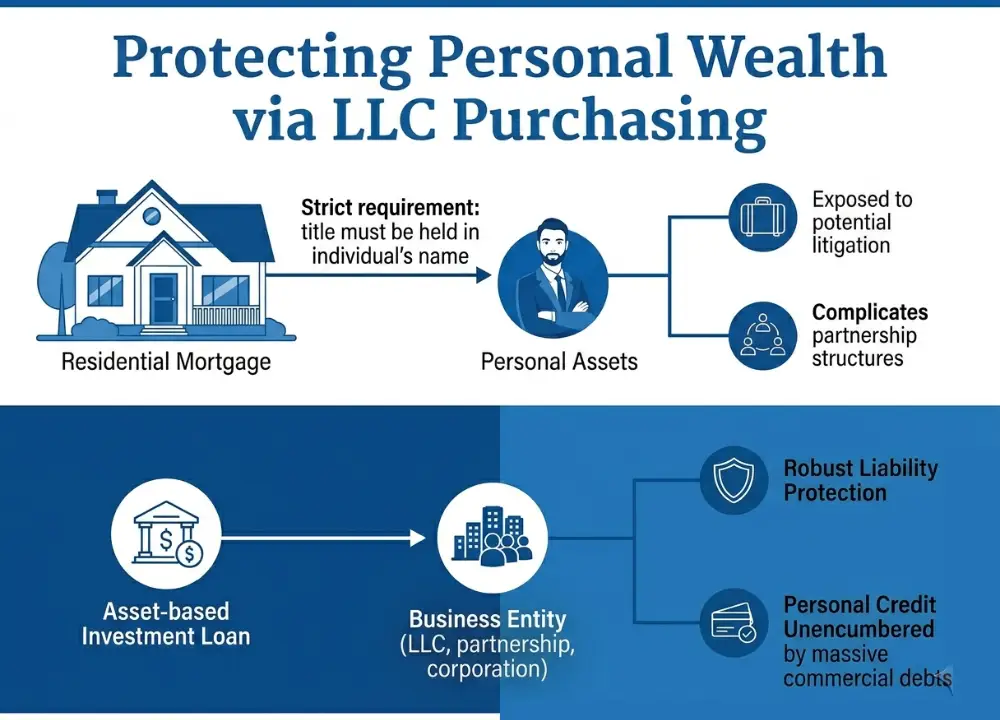
A significant operational drawback of traditional residential mortgages is their strict requirement that titles be held in an individual person’s name. For active real estate business owners, this requirement exposes personal assets to potential litigation and complicates partnership structures.
Asset-based investment loans are built with corporate structures in mind. Lenders actively encourage closing the loan under a business entity such as an LLC, a partnership, or a corporation. This structure ensures that your personal credit profile remains unencumbered by massive commercial debts while providing robust liability protection for your broader financial estate.
Determining the right financing mechanism depends heavily on your immediate business goals and your current operational setup. If you are purchasing a single investment property, have a predictable W-2 job, and do not mind a lengthy, highly invasive paperwork process, a traditional mortgage might provide a slightly lower interest cost.
However, if you are a self-employed business owner, operate through corporate entities, look to close deals quickly without personal DTI constraints, or intend to build a substantial portfolio of cash-flowing real estate assets, utilizing specialized investment capital is the clear choice. Working with a dedicated private money lender helps ensure your financing matches the speed, sophistication, and scale of your long-term investment strategy.
When you are ready to evaluate your next acquisition without the headaches of conventional bank red tape, contact the experienced team at Gauntlet Funding to explore tailored asset-based financing solutions engineered specifically for your investment objectives.
Financial Disclaimer
The information provided is for educational and informational purposes only. The content on this website is not intended to be a substitute for personalized financial advice. Please consult a certified financial professional before making any investment decisions or financial plans. Any financial information presented is for general informational purposes and does not constitute financial or investment advice.








