



For real estate investors looking to scale their portfolios, time is the ultimate currency. Conventional mortgages often slow momentum by requiring mountains of personal tax returns, debt-to-income verification, and employment checks. This is where DSCR Loans become a game-changer. Because these specialized investment property loans focus on the cash flow of the asset rather than your personal salary, you can bypass the traditional bureaucratic hurdles.
However, entering an underwriting process without knowing your numbers can stall your investment momentum. Before you submit an application, you can act like a lender by using a strategic method to forecast your qualifications. By understanding the core mechanics of investment property analysis, you can determine your approval odds, optimize your leverage, and approach your next deal with absolute confidence.
Unlike a traditional residential mortgage that evaluates your personal ability to pay, debt service coverage ratio financing treats your investment property like a business. The underlying question a private lender asks is simple: Does the monthly lease revenue fully cover the overhead expenses of the mortgage?
To answer this question, underwriting teams do not guess or rely on speculation. They utilize a formalized underwriting mechanism to balance risk and property performance. By taking the time to evaluate these metrics before submitting paperwork, you ensure a smoother transaction, protect your earnest money deposits, and position yourself to secure the most competitive interest rates and loan-to-value ratios available in the marketplace.
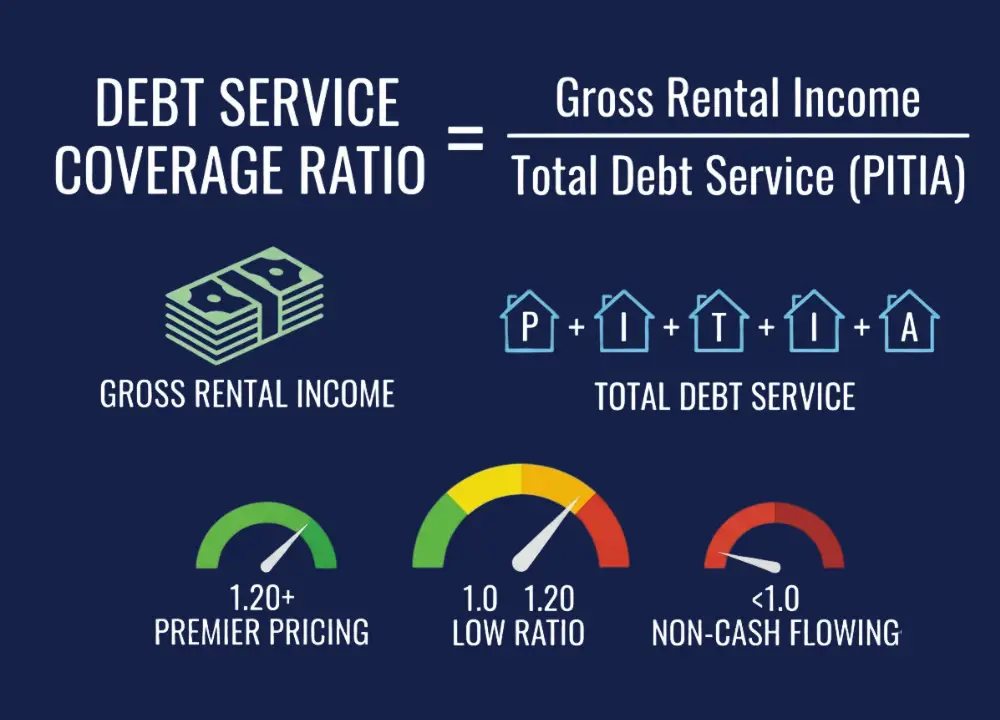
The foundation of this entire financing structure relies on one primary mathematical equation. To calculate exactly where your deal stands, you must master the fundamental DSCR formula:
Debt Service Coverage Ratio = Gross Rental Income / Total Debt Service (PITIA)
This mathematical ratio indicates the safety margin for the lender. A ratio of 1.0 means the property generates exactly enough revenue to cover the underlying debt. A ratio above 1.0 means the asset produces a positive cash flow, while a ratio below 1.0 reveals that the property is operating at a net monthly loss, meaning the investor must cover the shortfall out of pocket.
To accurately run this calculation, you must look at how a lender verifies the numerator of the equation. For a stabilizing or fully occupied asset, the underwriting team uses a conservative rental income calculation approach. They typically look at your fully executed lease agreements to establish baseline revenue.
However, the actual lease amount is only one piece of the puzzle. Lenders also require an independent appraisal report containing a Comparable Rent Schedule, known as Fannie Mae Form 1007, for single-family residences. In most conservative underwriting scenarios, the lender utilizes the lesser of the actual lease agreement or the appraiser’s market rent estimate to ensure the property performs in line with historical local neighborhood data.
The denominator of the equation represents your total monthly housing liabilities. To ensure your calculations match the lender’s appraisal, you must include every element of the PITIA acronym:
Neglecting to include HOA fees or accurate tax estimates is one of the most common pitfalls that can unexpectedly lower your final ratio during the closing process.
Every private financing institution establishes specific risk thresholds based on the final calculated ratio. For professional real estate investors, aiming for a ratio of 1.20 or higher is standard practice. A 1.20 ratio implies that the property’s gross monthly income exceeds the underlying housing expenses by twenty percent, providing a clear financial buffer against unexpected tenant vacancies or maintenance costs.
A debt service coverage ratio of 1.00x means a property is generating exactly enough net operating income to service its debt. Ratios above 1.00x provide a safety cushion for lenders, indicating that the asset has the financial bandwidth to absorb unexpected revenue drops or expense spikes.
If your calculation drops below the 1.0 mark, funding is still entirely possible. Many direct private lenders offer specialized low-ratio or no-ratio alternatives. However, properties that do not maintain positive cash flow usually require a larger down payment or a stronger borrower credit profile to offset the added operational risk.
To construct your own internal DSCR loan calculator spreadsheet, follow this exact step-by-step sequence before reaching out to a loan officer:
Collect all active, fully executed lease agreements for the subject property. If the property is currently vacant or undergoing a substantial renovation, research local neighborhood rental comparables within a one-mile radius to establish an accurate, data-driven expectation of what a professional appraiser will determine as fair market rent.
Obtain an accurate quote for your annual landlord insurance policy and verify the current year property tax assessments from the local county database. Combine these numbers with your estimated monthly principal and interest payments. Do not forget to look up whether the property sits inside a mandatory HOA community.
Divide your total verified monthly rental revenue by the comprehensive PITIA figure. For example, if a multi-unit property brings in 6000 dollars in total monthly rent and the complete PITIA payment sits at 5000 dollars, your calculation would look like this: 6000 divided by 5000, resulting in a healthy ratio of 1.20.

If your initial calculations reveal a ratio that is lower than your target threshold, you do not have to abandon the deal. Investors have several financial levers they can pull to transform a marginal property into a highly profitable transaction:
First, you can choose to make a larger initial down payment. By increasing your equity contribution, you reduce the primary loan balance, which directly drops your monthly principal and interest obligations and causes your ratio to rise. Second, you can explore purchasing interest rate buy-down points to permanently lower your ongoing monthly debt service liabilities.
Additionally, you can look for immediate opportunities to maximize the asset’s gross income. This might involve updating units to justify higher market rents, adding coin-operated laundry facilities, or leveraging short term vacation rental strategies through specialized booking platforms to significantly outpace traditional long-term lease averages.
Once you have run the numbers and verified that the asset meets your investment criteria, the final step is aligning with an experienced direct lender. Working with an institution that manages its own capital ensures that your deal is reviewed by internal underwriting teams who understand the rapid pace of the modern real estate landscape, saving you from the communication gaps often found when dealing with third-party brokers.
By preparing your corporate entity structures, organizing your historical property documentation, and calculating your numbers ahead of time, you can navigate the loan application with maximum efficiency. If you are ready to expand your real estate footprint and leverage your property’s cash flow to build lasting wealth, contact the experienced team at Gauntlet Funding today to explore tailored financing options built around your unique investment goals.
Financial Disclaimer
The information provided is for educational and informational purposes only. The content on this website is not intended to be a substitute for personalized financial advice. Please consult a certified financial professional before making any investment decisions or financial plans. Any financial information presented is for general informational purposes and does not constitute financial or investment advice.









