



For real estate investors, the traditional mortgage process can often feel like a hurdle race. Conventional lenders focus heavily on personal income, debt-to-income (DTI) ratios, and tax returns, which can be restrictive for self-employed investors or those with high-leverage portfolios. This is where DSCR Loans offer a powerful alternative. By focusing on the income potential of the property rather than the borrower’s personal paycheck, these loans have become the go-to financing tool for scaling rental portfolios.
A Debt Service Coverage Ratio (DSCR) loan is a type of non-QM (Non-Qualified Mortgage) loan specifically designed for real estate investors. Unlike traditional loans, the primary investment loan criteria for a DSCR loan is the property’s ability to generate enough monthly rent to cover the mortgage payment, including principal, interest, taxes, insurance, and association dues (PITIA).
Because the property’s cash flow is the star of the show, the application process is streamlined. Investors do not need to provide W-2s or complex tax filings, making DSCR Loans a faster and more flexible option for those looking to close on new opportunities quickly.
While DSCR loans are easier to qualify for than bank loans in terms of income verification, they still have strict requirements to ensure the investment is sound. Understanding these criteria upfront is essential for any investor looking to secure a competitive rate.
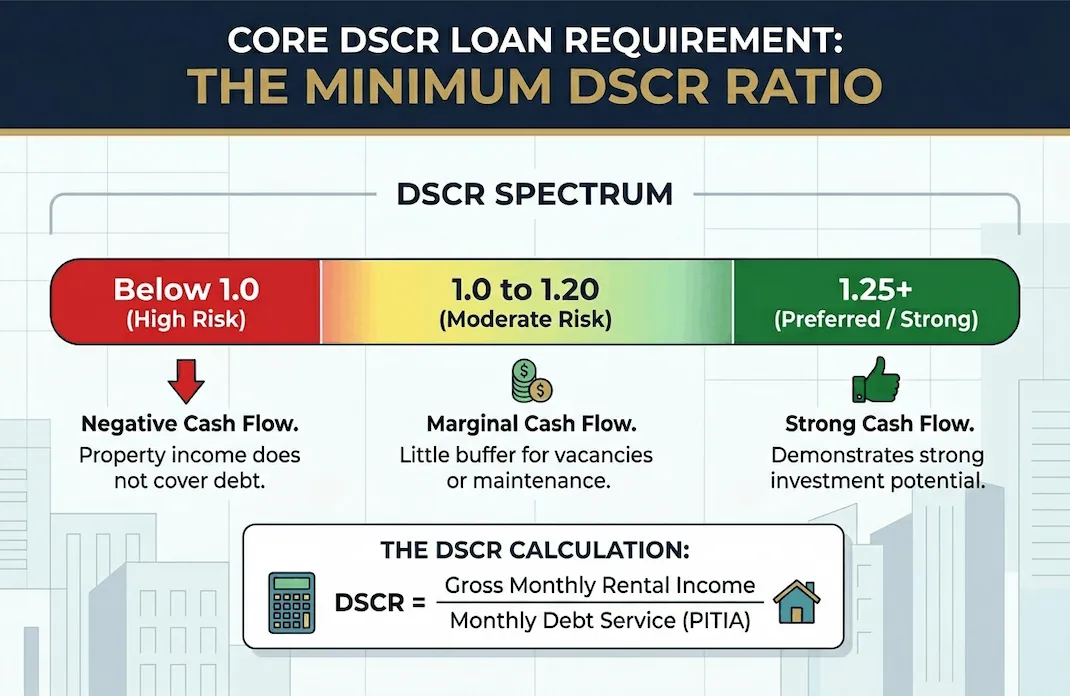 1. The Minimum DSCR Ratio
The most important factor is the DSCR calculation. Most lenders look for a ratio of 1.0 or higher. A 1.0 ratio means the property’s gross rental income exactly equals its debt obligations. Many lenders prefer a “cushion,” often requiring a ratio of 1.20 to 1.25 to account for potential vacancies or maintenance costs.
Even though your personal income isn’t the focus, your credit history still matters. Lenders use your credit score as an indicator of financial responsibility. Generally, a minimum score of 620 is required, but a score of 720 or higher will typically unlock the most favorable interest rates and lower down payment requirements.
Since these are considered higher-risk loans than owner-occupied mortgages, a larger down payment is usually required. Expect to put down at least 20% to 25%. A lower LTV (Loan-to-Value) ratio provides the lender with more security and often results in better loan terms for the borrower.
The property must be an investment—typically a single-family home, 2 to 4 unit property, or a long-term rental. A standard appraisal is required, along with a “Rent Schedule” (Form 1007) which helps the lender determine the fair market rent for the DSCR calculation.
To determine if a property qualifies, you must understand how rental property cash flow is measured. The formula is relatively simple:
DSCR = Gross Monthly Rental Income / Monthly Debt Service (PITIA)
For example, if a property generates $2,500 in monthly rent and the total mortgage payment (including taxes and insurance) is $2,000, the DSCR is 1.25. This indicates a healthy cash flow that exceeds the debt obligation by 25%.
“The debt-service coverage ratio (DSCR) is a measurement of a firm’s available cash flow to pay current debt obligations. In real estate, it is a crucial metric that helps lenders determine the risk of a rental property loan.”
— Source: Investopedia
The shift from personal DTI to rental property cash flow is a game-changer. For investors who have reached their limit with conventional “10-loan” rules or those who have significant write-offs on their tax returns, DSCR loans provide a path forward. The lender is essentially underwriting the asset’s performance rather than your personal employment history.
However, it is important to note that if a property has a DSCR below 1.0 (meaning it is “negatively cash flowing”), you can still find financing, but it often comes with higher interest rates or requires a larger down payment to reduce the monthly debt service until the ratio improves.
Yes. Many modern lenders allow you to use projected income from short-term rental data (like AirDNA) to meet investment loan criteria. This is a significant advantage for investors in vacation markets where traditional “long-term” rent estimates might not reflect the true earning potential of the property.
Often, yes. Unlike residential mortgages for primary residences, DSCR loans frequently include a prepayment penalty. This is usually a “step-down” structure (e.g., 5, 4, 3, 2, 1 percent over five years). Investors should factor this into their exit strategy, especially if they plan to flip or refinance the property within a few years.
While not always mandatory, most investors choose to close DSCR loans in the name of an entity like an LLC. This helps with asset protection and aligns with the commercial nature of the loan. You can learn more about how professional lenders view these structures at The National Association of Realtors.
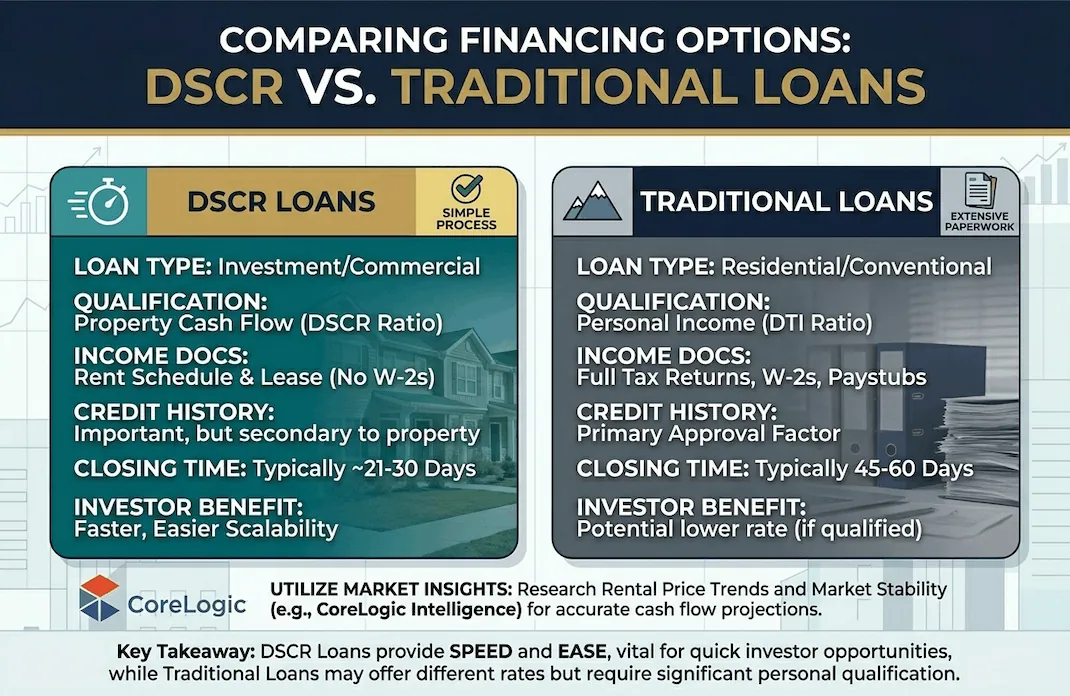 When evaluating your options, consider the speed and ease of the process. Traditional bank loans can take 45 to 60 days to close and require mountains of paperwork. A DSCR loan can often be closed in as little as 21 days because the lender is not performing a deep dive into your personal financial life.
For more insights on the broader market, CoreLogic’s Intelligence Blog provides excellent data on rental price trends and housing market stability, which can help you estimate your future rental property cash flow more accurately.
If your DSCR calculation is coming up short, there are several ways to improve your standing before applying:
Experienced investors often use Fix and Flip Loans to acquire and renovate a property, then “refi-out” into a long-term DSCR loan once the property is stabilized and producing income.
As the real estate market evolves, DSCR loans continue to gain popularity due to their scalability. Since these loans do not appear on your personal credit report in the same way a traditional mortgage does, they do not impact your DTI for future personal purchases, such as a primary residence. This separation of “business” and “personal” debt is vital for long-term wealth building.
Navigating the various investment loan criteria can be complex, but working with a direct lender ensures that you are getting the most transparent terms available. If you are ready to expand your portfolio without the headache of tax return verification, it is time to look at how these specialized products can work for you.
For more information on customized lending solutions and how to secure your next investment, contact the experts at Gauntlet Funding LLC.
Market Insight: According to recent industry reports, investor activity remains a significant portion of the housing market, with investors purchasing approximately 16% of all U.S. homes sold in recent quarters, highlighting the continued demand for flexible financing options like DSCR loans.









