


Securing a distressed multi-family building or an off-market house flip requires capital that moves at the speed of the market. Traditional bank mortgages, tied down by months of bureaucratic personal underwriting, simply cannot compete in these scenarios. This reality drives real estate professionals to leverage the speed of hard money lenders. Because these private capital providers back the asset rather than your personal tax history, an obvious question arises: do you still have to wait around for a traditional structural appraisal before getting your funds?
The short answer is yes, but the evaluation mechanism looks completely different from a standard bank checklist. Conventional underwriters scrutinize your personal debt-to-income ratio first and use a property valuation merely to rubber-stamp their loan limits. Private equity teams flip that script. They look directly at the asset’s raw equity and future profit potential. Understanding how a private lender calculates a property’s true worth will dictate your down payment, your project leverage, and how fast you can cross the closing finish line.

To grasp why asset evaluation is so critical, it helps to understand the foundational principles of private money loan underwriting. Private debt providers take on significantly more risk than traditional commercial retail banks. They fund projects in a fraction of the time, often closing deals in days rather than months, and they routinely finance distressed properties that a traditional underwriter would reject immediately.
Because the real estate asset itself serves as the primary security for the borrowed capital, protecting that position through accurate risk mitigation is paramount. If a borrower defaults on their payments, the private investment group must be completely confident that the physical asset holds enough intrinsic value to recover the outstanding balance. Consequently, evaluating the property thoroughly is not just a regulatory checkbox; it is the core foundation upon which the entire financing agreement is constructed.
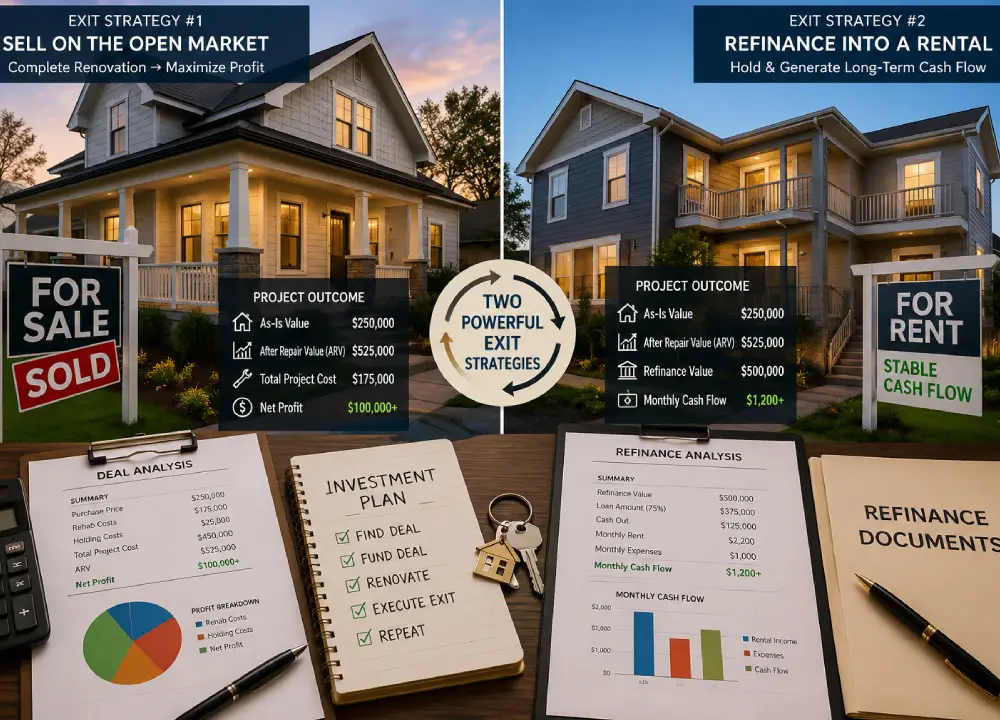
Unlike traditional residential mortgages that only look at what a property is worth today, a private financing underwriter focuses heavily on two distinct figures. The first is the current value of the structure in its unrenovated state. The second, and arguably most important figure for a house flipper, is the After-Repair Value, which predicts the open market worth of the home once all planned renovations, structural updates, and cosmetic improvements are fully executed.
Rather than using traditional loan to value guidelines, a specialized real estate investment group will structure their funding limits around a percentage of the calculated future equity. Most private equity providers will advance up to 70% or 75% of the projected post renovation value. This specific mathematical boundary leaves a safe equity cushion for both the investor and the financial backing group, ensuring the project remains structurally profitable even if local market conditions shift unexpectedly during the construction phase.
While an evaluation is almost always mandatory, private financing groups utilize a variety of modern valuation methods to keep transactions moving forward without the standard administrative delays associated with traditional banks.
“In highly competitive real estate environments, cash offers and alternative asset-based financing structures account for more than a quarter of all residential investment transactions, driven by the absolute necessity for rapid project evaluation and quick closing terms.”
— National Association of Realtors Housing Statistics Report
Depending on the complexity of the deal, the overall condition of the home, and the total amount of capital being requested, a private equity partner may deploy one of three primary assessment strategies to establish a baseline for your funding approval:
For large scale rehabilitation projects, commercial structures, or multi-unit conversions, private groups will order a full independent investment property appraisal. A certified local appraiser will physically visit the location, inspect the current state of the foundations and interiors, and carefully evaluate the investor’s comprehensive line item renovation budget to determine if the projected future valuation is realistic and obtainable based on recent hyper local neighborhood data.
When an investor needs to close a deal with extreme speed, a traditional walkthrough may take too long to schedule. In these time-sensitive scenarios, underwriters often opt for a Broker Price Opinion. A licensed local real estate broker is hired to quickly evaluate the property based on active listings, pending contracts, and recent sales patterns in the immediate area. This method provides a reliable, professional estimation of value in a fraction of the time required for a traditional report.
For experienced investors with a long, proven track record of successful projects, or for properties located in highly active suburban subdivisions with deep historical data sets, a lender might utilize a desktop visual assessment. This digital process relies on advanced mapping technology, public county records, and automated algorithms to verify the neighborhood baseline without requiring a formal physical inspector to visit the site, allowing for unprecedented funding speed.
It is easy for an ambitious investor to view the valuation process as an unnecessary financial hurdle or a bottleneck that slows down their acquisition. However, a professional independent analysis provides an invaluable safety net for the borrower just as much as it does for the financial backing group.
Real estate markets can be highly unpredictable, and emotional bias can easily cloud an investor’s judgment when bidding on a hot property. If an independent local expert reviews your construction scope and determines that your projected future selling price is overinflated, it allows you to step back and re-evaluate the deal. Discovering that a project’s margins are too thin before you sign the closing papers can save you from a catastrophic financial mistake.
Additionally, a detailed structural report helps validate your construction budget. If local comps show that buyers in that specific neighborhood do not pay a premium for high-end luxury finishes, you can adjust your renovation strategy to avoid over-improving the property, thereby maximizing your actual net return on investment.
When preparing your deal for submission to a private money underwriting team, keeping these core elements in mind will dramatically improve your chances of obtaining a rapid, seamless approval:
By treating the property evaluation process as a collaborative tool rather than an administrative roadblock, you can navigate the private underwriting space with complete confidence and leverage your capital to its absolute highest capacity.
At Gauntlet Funding, we provide the localized expertise, responsive service, and direct asset-based capital necessary to turn your real estate ambitions into tangible financial success. Our streamlined underwriting platform is designed by investors, for investors, ensuring your projects get funded without traditional institutional delays. Contact our professional financing team today to discuss your next acquisition and secure the competitive terms your project deserves.
The information provided is for educational and informational purposes only. The content on this website is not intended to be a substitute for personalized financial advice. Please consult a certified financial professional before making any investment decisions or financial plans. Any financial information presented is for general informational purposes and does not constitute financial or investment advice.









